Elisabeth Koppensteiner from Lower Austria is the co-founder of the internationally active „Nature in the Garden“ initiative. Elisabeth Koppensteiner stands 100% behind the criteria of ecological and nature-oriented gardening. With her experience and knowledge from 25 years of managing the „Natur im Garten“ garden telephone, she also supports us with the free BIO-GARTENdoktor on her website for pests and diseases. The author of books and garden turntables has been running the company „GARTENleben“ since 2010, which produces compost tea, among other things, and writes columns as a garden chatterbox. She sees herself as a mediator between science and the plant world.
Contents:
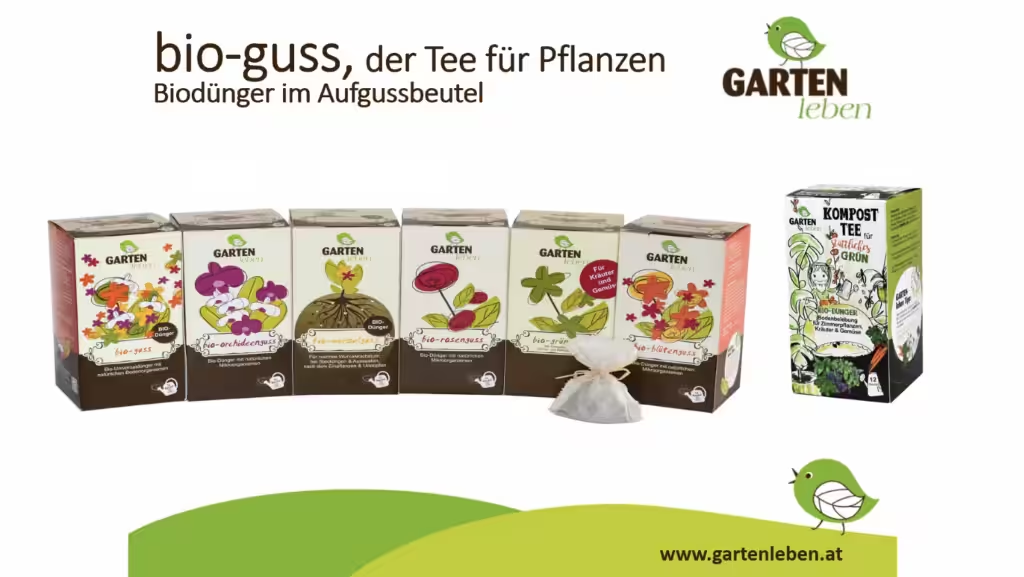
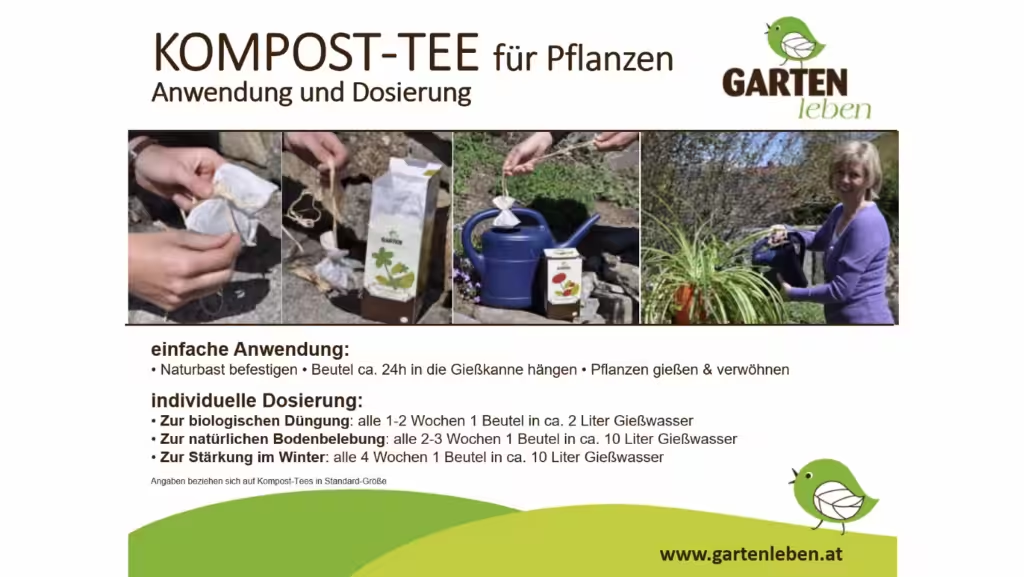
Elisabeth Koppensteiner talks about how we can strengthen our plants and how they, in turn, strengthen us. In this talk, she discusses houseplants, their needs and their function as important pollutant filters. We will talk about the strengthening and fertilizing effect of compost tea, which you can buy from her in tea bag form, and how you can easily make compost tea yourself. She presents the research results on compost tea, which we here on the website can read about.
For the great organic balcony movement: The first 50 orders will receive her book „Flowers for Heart and Soul“ as a gift. Plus a well-packaged offshoot of a green lily. „I have so many cuttings that if I pack them in a damp bag, they survive well and people immediately have a really great „houseplant“. Maybe it’s the first step for some and I’m happy when the little plants get a new home.“ Thank you Elisabeth!








27 Responses
Dear Birgit, I have just listened to Elisabeth Koppensteiner’s presentation. Because I also find the compost tea very practical, I will be happy to order it. I can’t get to grips with your instructions — everything is linked below. Where should I press? I don’t have a PC, only a tablet, so I have nothing to press… I would at least like to have her email where I can order the compost tea. Thank you.
If you still feel the same way, here is the compost tea https://www.gartenlebenshop.at/shop‑1/bio-kompost-tee/
Kind regards from Birgit
Hello dear interested parties!
If you don’t want to order via (m)a WEB store, you can also call me. My cell phone number is +43 (0)650 66 921 21, I will listen to the mailbox, please give me your exact address and phone number, otherwise I cannot send it with the parcel service. I will enclose an invoice with the delivery, but unfortunately I also have to charge postage costs.
Thank you so much, dear Elisabeth, for another valuable and enriching talk. The compost tea inspires me again and again, I have already given it as a gift especially for roses. Ah yes, I am from Upper Austria and understood everything very well, for me it was even very beneficial and so natural.
Can the compost tea also be used to fertilize cacti, especially Christ’s thorn? Since I moved house this year and repotted it, it has stopped flowering. Before that it was never without flowers. But I didn’t dare to try it with compost tea.
Kind regards Silvia
Dear Silvia!
I am very pleased about your feedback.
For cacti, compost tea is an ideal soil revitalizer and smart fertilizer. Even in winter, when many plants are under stress (location, temperature etc. may not be ideal), compost tea applied every 6 weeks supports the cacti as well as other plants with the soil microorganisms.
Does the Christ thorn perhaps get too much water or is it dry for too long (once a week in the summer season, in the winter season it can be less often, also depends on the size of the cane)? Both prevent flowering. The substrate should be rather lean, mixed with sand and rather acidic. You can „acidify“ the substrate with coffee brew.
Wish you the green thumb and I am sure that you will get it back with the compost tea at the Christusdorm.
Best wishes to Upper Austria!
Elisabeth
Dear Elisabeth,
Thank you very much for your reply. Oh dear, it may well be that I really have watered it too much. I used cactus soil. Compost tea has been ordered and he will also get coffee brew. Thank you very much.
Kind regards
Silvia
Dear Ms. Koppensteiner,
Your dialect is wonderful, that makes you sooo likeable!
Well, that was another wonderful lecture — thank you very much. This prompts me to ask you the following questions — but first as follows: I have 2 ivy plants in my large living room that grow beautiful green/white leaves. The dragon tree is also growing well. These three plants are either on a smaller flower stool or on the floor. The sun’s rays shine on them in turn, which seems to do them good. The elephant foot, also known as the bottle tree or the actual name of the plant is Beaucarnea. It has accompanied me through my life for sooo long and always grows very long leaves about 1.50m long. It stands high up on a flower stool above the others. Beaucarnea: What worries me is: 1) The leaves always snap off; 2) The skin always looks as if it is about to burst which — thank God! — has never happened. When I see other plants of this species, they always have a smooth body.
Now my question is: Which compost tea do you recommend for the Beaucarnea? And which compost tea for the ivies and the dragon tree?
Thank you very much for taking the time to answer our questions. All the best…
Hello Mrs. Manuela!
I’m happy when I don’t offend people with my dialect but even come across as likeable, thanks for that.
The organic green compost tea is ideal for the ivy, the dragon tree and also the Beaucarnea. In my opinion, plants, like us humans, are very different, even though they belong to the same species. 1.50 m long leaves need a lot of stability so that they don’t bend. Perhaps it helps to give almost no nitrogen so that the leaves don’t grow so large. The compost tea invigorates, strengthens and fertilizes lightly, making it ideal for Beaucarnea and many other houseplants, even in winter as mentioned above.
I think it’s very nice that you are so „friends“ with your Beaucarnea. Plants are such sensitive creatures and realize that. I think talking to them and being well-disposed towards them is good preventative plant protection!
All the best for you and your plants, Elisabeth
Hello Mrs. Koppensteiner,
Thank you very much for your reply. I wish you continued success in all your activities.
Best wishes from Bremen, on the Weser
Thank you very much for the lecture!
You can also use effective microorganisms. Greetings from Hellerau!
Gesine
Good evening Ms. Gesine!
Thank you for your feedback. Effective microorganisms are definitely recommended. There are some lab-grown strains in there, mostly none that survive in the soil, including sugars, so they are definitely good for the plants.
Compost tea contains nature’s wide range of microorganisms (currently 40,000 known strains).
Best regards back! Elisabeth
Dear Ms. Koppensteiner, great informative lecture, thank you very much. I had already given up on houseplants because the fungus gnats were so annoying. I have now realized again how valuable plants are for the indoor climate, especially in the dark season. Your contribution about the light conditions for the respective plants is also very valuable. Compost tea is at the top of my list for the next planting year.
Best regards, Bianca P
Dear Mrs. Bianca!
Thank you for your feedback. Your houseplants would be happy to receive 2–3 compost teas in winter and would certainly thank you for it.
Kind regards, Elisabeth
A very sympathetic presentation, danke❣️
However, the information on carbon monoxide in the bedroom should be corrected in the wording and text, it was certainly carbon dioxide that was meant, which plants can utilize. People would fall asleep within minutes if they inhaled carbon monoxide.
Thank you very much for your feedback. You are right, of course. Despite being nervous, I shouldn’t confuse carbon monoxide with carbon dioxide. Hopefully I didn’t repeat this mistake on the slides, I only found carbon dioxide.
Thanks again and best regards
Elisabeth
Thank you very much for your feedback Ms. Koppensteiner, I only mentioned the confusion of gases because it is actually written in the text that is shown from the 20th minute onwards. It would therefore be good to change this. Thank you and best regards!
I have had my worm composter for over 10 years and since then my thumb has become greener and greener and my „little ones“ have really grown on me, they are so industrious and tireless.
Cheers to the compost worms💚
Hello dear Antje!
Thank you for your feedback too. Yes, of course the compost tea also works in a rainwater barrel. It just shouldn’t be full so that it is emptied within a day or two. Then take out the bag, use it again and then fill the rainwater barrel with new (rain)water so that everything is washed through.
Kind regards
Elisabeth
I can only agree with this high and also extend it to all non-visible soil microorganisms!
Best regards
Elisabeth
Hello, that was a very nice lecture and I learned a lot, even though as a Saxon I sometimes had to prick up my ears 😃 I have one more question: can you also prepare the compost tea in a rain barrel (100l)? Most of my balcony plants depend on drip irrigation. Many thanks to Elisabeth and Birgit for all the great contributions!
Thank you very much, Ms. Koppensteiner, for this great contribution.
I have a question about worm tea and/or Bokashi…
I live in a rented apartment in Berlin and bought a worm farm a few years ago after my first participation in the BB Congress. Unfortunately, fungus gnats took up residence in it, it was really bad!!! Even after restarting the box, I had fungus gnats again. That’s why I now have a BOKASHI and I’m delighted. Since then I haven’t had to complain about any fungus gnats or similar.
My question:
The worm farm is called worm tea and bokashi is called effective microorganisms (EM).
Is that the same?
The use of the product is usually discussed as a matter of course, but how much and how often is unfortunately still not entirely clear to me.
I use 250ml per 5L of watering water and try to remember to do it once a month.… but unfortunately I sometimes forget. I have mixed organic soil with sand and grit, use sheep’s wool pellets and have a south-west facing balcony. In spring I sprinkled in some horn meal. I planted native organic wild plants with 95% and despite everything I have a really beautiful flowering of ALL plants! I have a Knautia without a single flower, just green! I have 4 fire beans in a pot (20cm deep) and had exactly 2!!! beans harvested.
What can I do to ensure that pleasure doesn’t turn into frustration and that I finally have a magnificent display of flowers on my balcony?.
Thank you very much
Dear Sandra!
My compost tea is a mixture of dry worm humus (from agricultural worm farms), herbs and informed rock flour in a tea bag. This tea bag is then hung in the watering can for around 24 hours and the compost tea is then poured over the plants.
Worm tea from an Upper Austrian is, as far as I know, the juice that runs out during composting in the „small worm farm“ and is diluted before use. Bokashi is the fermentation of organic waste and, as far as I know, some microorganism culture strains are propagated in EMs, all of them anerobic, as they have to survive in water without oxygen for a long time. Unfortunately I have no experience with widow flowers in pots, they grow and flower in my garden, but I could imagine that they are not very happy in pots as they have deep roots. Fire beans are weak growers, so they need little nitrogen, as they collect nitrogen from the air themselves and stop growing if there is too much heat. But Birgit is certainly the better person to talk to about balcony gardening.
I hope I have been able to clear up your confusion and wish you the green thumb. Everyone needs time to learn, your plants will show you a lot.
Kind regards
Elisabeth
Good evening,
It was a wonderful talk and now I have to digest it. All this information and different compost teas will take a while. Thank you very much!
Thank you for your kind feedback!
Dear Ms. Koppensteiner,
Thank you very much for the interesting presentation!
My question: Can’t microorganisms in the potting soil also harm people — with or without compost tea? How can this be avoided?
Best regards
Christel Bialek
Dear Mrs. Bialek!
Mold in the pot, in the soil, that can harm us, so no waterlogging, too moist — just look and possibly also smell whether the pot, the plant or even the watering can has no mold anyway.
The compost tea, stored dry, used as recommended, poured out, the watering can refilled with fresh water, nothing can happen. On the contrary, a study with the Graz University of Technology and the Medical University showed that plants (a green lily was tested in a glass box over a longer period of time), when watered with compost tea microorganisms, release even more diverse microorganisms via the leaves, which are good for the environment. (See slide) In other words, the plants are good for our immune system or you breathe what you water.
I hope I have answered your questions and wish you a pleasant Sunday.
Your plant chatterbox Elisabeth
Hello Elisabeth,
Thank you for the informative presentation.
About 5 years ago I developed my own version of compost tea, so to speak:
We collect coffee grounds and tea residue, i.e. liquid tea that has not been used, as well as fine residue from the tea filter plus cooking water that has not been cut, in a container in the kitchen. This can collect there for weeks and eventually starts to smell a bit like plant manure. We use this to water the houseplants once a week.
What I only noticed through your lecture: none of them got sick anymore. Exception: non-hardy herbs that we tried to overwinter indoors.
We didn’t need any further fertilization either.
The only problem: guests who would like us to pour out the „dirty water“.
Are eM perhaps also formed there? I remember that our dog sometimes liked that too.
Best regards
Birgit Ramos
Hello Birgit!
EMs are a company term that is quite well known, as far as I know. These EMs are specially cultivated microorganisms, but only a few strains. Compost tea contains microorganisms in the variety and breadth that nature provides. Many microorganisms will also form in your irrigation water. As with compost tea, it naturally depends on the starting material. Countless strains will then form, so it is impossible to say exactly what they are without determining them. If the water stands for a long time, then only the anerobic microorganisms, i.e. those that do not need oxygen, are left inside. You don’t want mold to develop, that would be important. Otherwise, if your plants grow nice and healthy, it will do them good and therefore suit them. I wish you continued green fingers!
Best regards, your plant chatterbox Elisabeth